Most of the contractors we work with have production figured out. The equipment is dialed in, the process works, and the jobs finish clean. The harder question is finding the people to run it.
There is a simple reason hiring in the trades works differently than hiring anywhere else: the crew members you want most already have jobs.
That single fact explains why a job listing can sit for weeks without producing a good candidate, and it points directly at what does work.
Why job boards reach a smaller pool than you think
A job board is a search engine. Someone decides to leave their current position, opens a listing site, types in a trade, and scrolls. Your posting appears in a list beside every other contractor in your area hiring for the same role.
That model works well when a lot of qualified people are actively searching. In the trades, fewer of them are.
Picture the crew member you would most like to hire. Six years of experience, reliable, runs a tear-off without touching the landscaping. That person is on a roof today, not browsing listings on a Tuesday evening.
They might well move for two dollars more an hour, a shorter drive to the yard, or a schedule that respects their weekends. They are simply never going to see a posting they are not looking for.
Job boards reach people who are already searching. In the trades, that is a small group, and every contractor within thirty miles is recruiting from it.
What reaching them actually costs
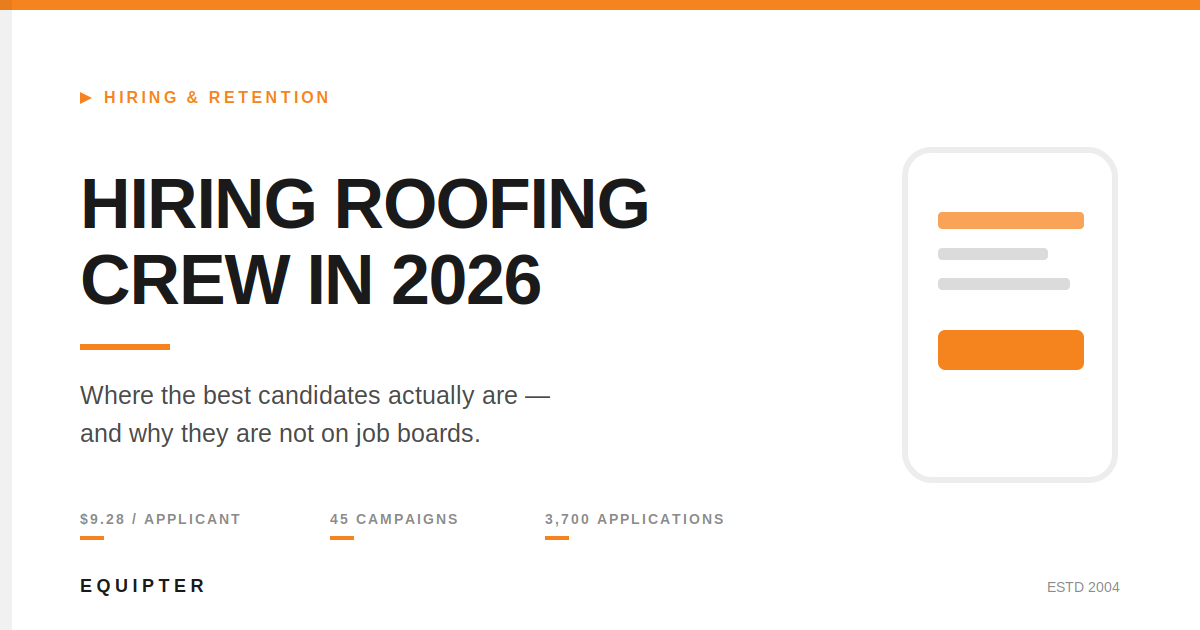
Boostpoint runs recruitment advertising for construction and trades companies and shared their 2025–26 results with us. Across 45 field and trades campaigns, covering roughly 2.6 million ad views and 3,700 applications:
Average cost per applicant $9.28 · Typical range $6–$17 · Cost per click $0.84 · Application completion rate 9.1%
Set that against what an open position costs you. A role that stays unfilled through peak season means overtime, crews running short, and jobs pushed further out on the calendar. Against that, roughly nine dollars to put your opening in front of a qualified candidate is one of the least expensive parts of hiring.
The number worth acting on
Look at that final figure again: 9.1% application completion.
Of every 100 people who tap a job ad and begin an application, about nine finish it. Boostpoint reports that is the lowest completion rate across any industry they advertise for — manufacturing and trucking both clear 16%.
The gap has less to do with interest and more to do with circumstances. Consider where a working candidate is when they see your ad: on a job site, mid-shift, one hand on a phone, limited signal, and a minute or two before they are needed again.
A fifteen-field form asking for a full work history and an uploaded resume is a reasonable request in an office. It is not a reasonable request on a roof. The application is not filtering for commitment — it is filtering for who happens to be sitting at a desk.
Ask two or three questions. What equipment can you run, how many years have you been doing it, and can you reach the yard by 6:30. Everything else can come out in the phone call you were going to make anyway.
Run separate ads for crew and sales roles
This matters for most residential roofing and home improvement companies, because they are usually hiring for both at once.
Crew roles cover tear-off, installation, labor, and foremen. Sales roles cover canvassers, appointment setters, and the people who close at a kitchen table. They are different hires and they need separate campaigns.
In Boostpoint's data, sales and customer-facing roles averaged around $6 per applicant while field and trades roles ran closer to $9. The sales roles also generated considerably more volume.
Combine the two into one campaign and the easier hire crowds out the harder one. You end up with a full pipeline of sales applicants and the same open crew positions you started with.
Sales ads work best when they lead with earning potential and flexibility. Crew ads work best when they lead with pay rate, hours, and yard location. Keep them separate and both perform better.
What belongs in the ad
This applies whether you run the campaign in-house or bring in help.
- Pay rate in the first line. A real number or a real range rather than "competitive pay." It is the first thing anyone looks for, and specifics earn more applications than generalities.
- Hours and start time. If the day begins at 6am, say so. Being upfront saves both sides a week.
- Where the work is. Yard location or general service area. People are willing to drive — they just want to know how far before they apply.
- Video outperforms a still photo. Phone footage is fine. Your crew, your trucks, a real job site. Experienced candidates can tell immediately whether a company knows the work.
- Refresh it every few weeks. The same ad running for four months loses effectiveness. Most campaigns that work well for a month and then stall simply need new creative.
Call back the same day
This may be the highest-return item on the list, and it costs nothing.
Someone looking for work typically applies to three or four companies in one sitting, often on a break. Whoever calls first reaches a candidate who is still weighing the decision. Call on Thursday about an application submitted Tuesday and there is a good chance they have already accepted somewhere else.
If same-day callbacks are not realistic yet, decide who owns that step before turning any advertising on. The response process is what converts applications into hires.
Where equipment fits into hiring
Finding candidates is one half of the problem. Keeping them is the other, and that is where the way your job sites run starts to matter.
The Equipter® 4000 was built to take the heaviest, least rewarding part of a tear-off off your crew's shoulders. Debris goes straight from the roofline into the container instead of onto tarps and into wheelbarrows. The lawn stays intact, cleanup stops eating the end of the day, and crews finish with something left in the tank.
That shows up in recruiting more than most owners expect. Experienced crew members compare working conditions, and a company known for running clean, well-equipped job sites has an easier time attracting people and holding onto them. It is more than equipment — it is a business multiplier.
The bottom line
The crew members worth hiring are not scrolling listings on their night off. They are on their phones like everyone else, which is where your opening needs to be — with a short application, a real pay rate, and a callback the same day.
About the data
All figures in this article come from Boostpoint's 2025–26 campaign data across 45 construction and trades campaigns. Their full skilled trades hiring breakdown covers cost by trade, what moves the number, and where the approach works less well.
Boostpoint runs managed job advertising for companies hiring frontline workers. This article was contributed by Boostpoint and edited by the Equipter team.
Share this article